02 — Know your space
Dimensions, lighting, and 3D planning — the step that saves you the most money.
Buying without measuring is like cooking without a recipe. You might get lucky, but most of the time you end up with something that doesn't work — a desk that's too wide for the wall, shelves that clash with the monitor arm, a rug that gets swallowed by the furniture around it. This chapter is about eliminating that guesswork entirely.
Start with a 3D model
Whether your space is empty or already full of furniture, my first step is always the same — I build a 3D model of the room. Not to make it look pretty, but to have an accurate, to-scale representation of the space I'm working with before I commit to a single purchase.
I use Blender, which is my personal favourite. It's free, incredibly powerful, and once you know it you can model anything. It takes me around 20 to 30 minutes to recreate a room accurately in Blender — I input all the perimeter measurements, the ceiling height, and I make sure to include details like the skirting board.
That said, Blender has a steep learning curve and I know it's not for everyone. If you want something simpler, here are three beginner-friendly free alternatives that work directly in your browser with no technical knowledge required:
Planner 5D — has a free version that works for basic layouts, but access to premium furniture and high-resolution rendering requires a paid subscription. Good enough for planning room dimensions and desk placement, but you'll hit paywalls for nicer furniture models.
Floorplanner — has a free plan that lets you create one project with basic features. Sufficient for a single room layout which is all your audience needs.
Coohom — the free version offers a limited selection of about 8,000 models, with paid plans required to unlock the full catalogue. That said, 8,000 models is still plenty for planning a desk setup space.
And if none of those appeal to you, the simplest option of all still works perfectly: pen, paper, and a tape measure. Draw the perimeter of the room to scale, mark every wall, door, window, and fixed element, and treat it like an architect's floor plan. It's low-tech but it forces the same rigour.
I also use AI tools like ChatGPT, Claude or Nano Banana Pro to generate layout ideas and explore possibilities I might not have considered. Describe your room dimensions or upload an image of the room plan and what you want to achieve, and you'll often get surprisingly useful spatial suggestions to test in your model.
Where to place the desk
Every room is different, so I can only speak from my own approach — but the principle behind it applies universally: place the desk where the light works best for how you actually use the space.
I always position my desk against the wall with the window to my left. This gives me the best natural daylight for filming without the light hitting my monitor directly, which reduces reflections and makes working more comfortable. It's a decision that serves both function and aesthetics at the same time — which is always the goal for me.
The rug — plan for it before you buy anything else
Most people think about the rug last, if they think about it at all. It usually gets added after everything else is placed, which is exactly when it becomes hardest to get right. Plan for it here, at the space planning stage, before a single piece of furniture is purchased.
A rug does three things simultaneously: it grounds the space visually, it defines the desk area as its own intentional zone within the room, and it treats the acoustics by absorbing echo — which matters enormously if you record audio or video at your desk. A room without a rug sounds hollow and looks unfinished, regardless of how good everything else is.
Size is the most important decision. Go too small and the rug makes the space feel cramped rather than expansive — a small rug under a large desk is one of the most common mistakes in setup design. My current rug is 160 by 240cm and that's roughly the minimum I'd recommend for a full desk setup. If your space allows it, go bigger. Never go smaller.
For texture, choose short pile. High pile rugs look cozy in photos but your chair will sink into them and rolling across the surface becomes a daily frustration. Short pile gives you visual warmth without the friction.
For colour, follow your theme. A dark rug for a dark setup, lighter natural tones for a lighter environment. The rug is one of the largest surfaces in the room and it anchors the entire colour palette — choose it with the same intentionality you'd apply to the wall colour.
Measure for it now, in your 3D model, before you commit to desk dimensions or furniture placement. A rug that's too small is almost always the result of not planning for it early enough.
Measure the wall, not just the floor
Most people measure the floor space for their desk and stop there. But the wall in front of you is equally important — and often overlooked until it's too late.
That wall is where you'll hang shelves, acoustic panels, art, or any vertical elements that define the visual backdrop of your setup. If you're planning to get a standing desk, you need to think about this carefully. A standing desk at full height combined with a monitor and a desk shelf can easily collide with a wall shelf positioned too low. Plan the vertical space before you buy anything that mounts to the wall.
When the space isn't perfect
Rooms are never ideal. There are columns, alcoves, awkward angles, pipes in inconvenient places. I once bought an Ikea Karlby countertop for a corner space in my parents' living room, only to find a small column slightly protruding from the wall exactly where I needed to place it. My solution was to cut the corner of the desk at an angle to match the column — it worked perfectly and actually looked intentional.
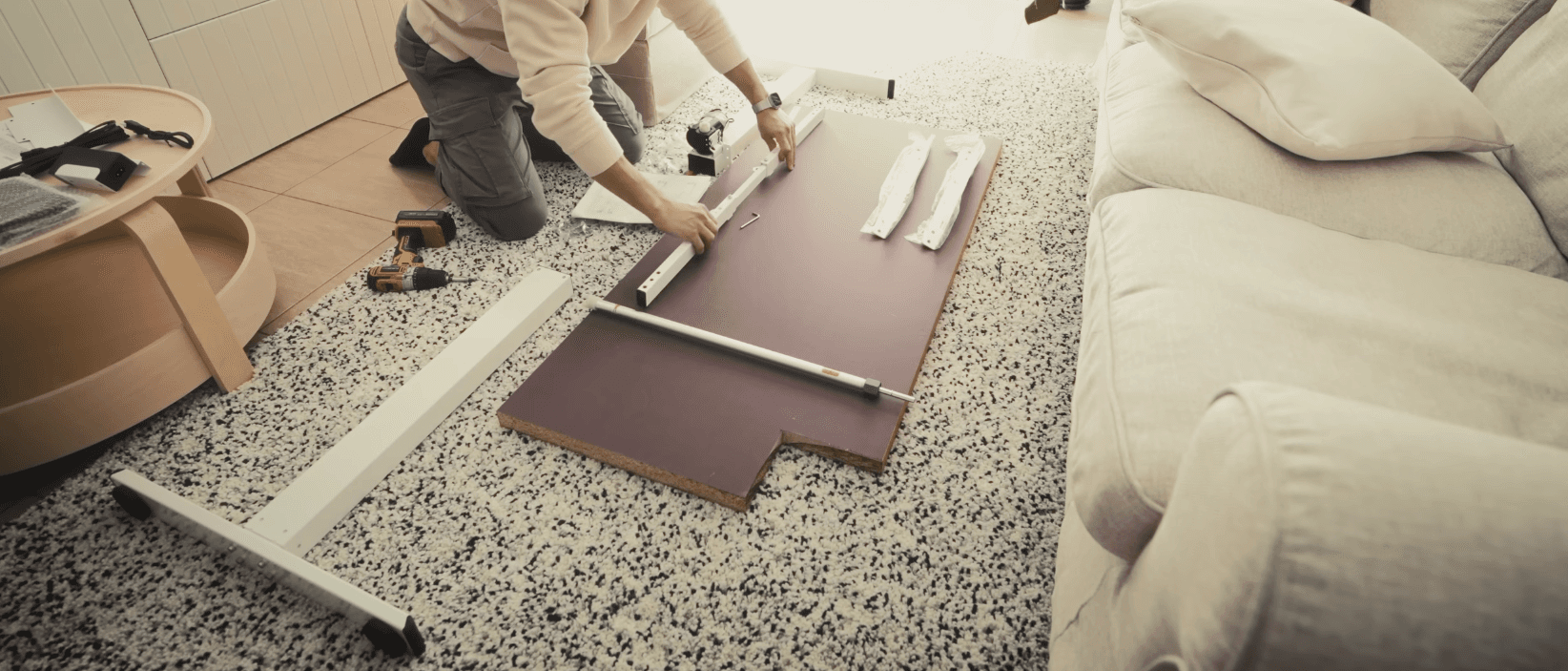
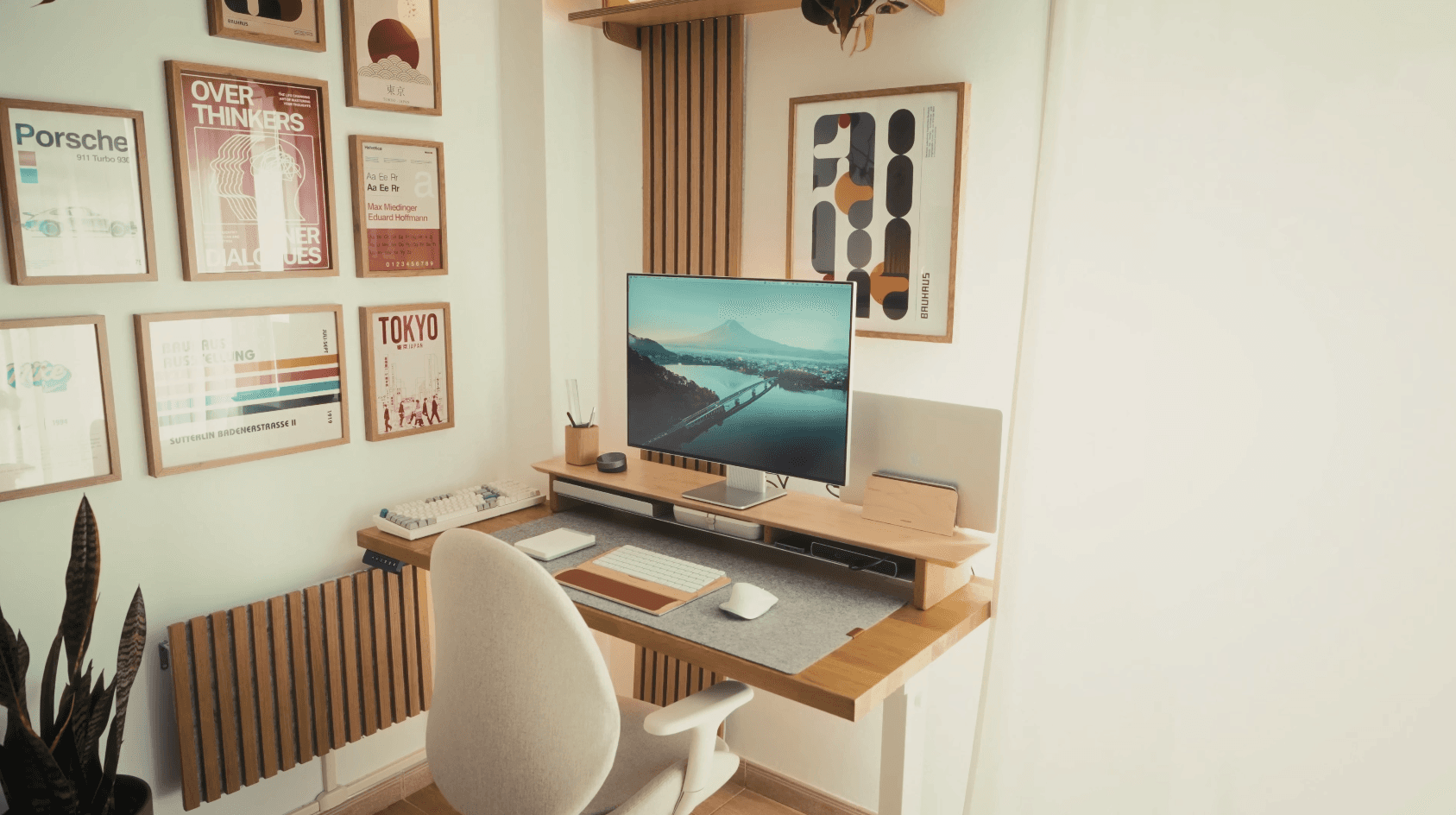
But I want to be clear about something: that only worked because it was an Ikea countertop. If that had been a premium desk from Balolo or Grovemade, I would never have bought it for that space in the first place. An expensive piece deserves a space that fits it properly.
The point of all of this
Every minute you spend understanding your space before you buy saves you money, time, and the specific frustration of receiving something that doesn't fit.
Model it. Measure it. Then shop.